Klang
Chicago pianist Josh Harlow and Detroit percussionist Jonathan Barahal founded Teiku around the concept of using their respective families’ unique Passover melodies as conduits for new forms of spontaneous musical expression. Their self-titled 2024 debut was a meditation on their shared history and a tribute to the ancestral melodies that they grew up singing. Sophomore album Klang expands on this reinterpretation of traditional sounds by drawing source material from the wider community, rare manuscripts, voice recordings, and memories of late-night ritualistic chants. Five of Klang’s six tracks represent the same Passover song/liturgical text, with each becoming a completely distinctive and unique melody when filtered through regional and family variations.
Reflecting on the intention behind Teiku, bandleaders Harlow and Barahal said, “The process of reframing our ancestral melodies to make this music reminds us to keep searching and imagining. As Jews we embrace our spiritual and cultural heritage of care and community, of rituals and questions. We reject all forms of state violence that have become associated with that heritage by power crazed genocidal nationalists. To that end we dedicate this set of music to the Palestinian people and all suffering people.”
Teiku is made complete by bass clarinetist Jason Stein (Natural Information Society, Hearts and Minds) and bassist Jaribu Shahid (Sun Ra Arkestra, Art Ensemble of Chicago, Griot Galaxy), and the group moves fluidly between frenetic density, subtle timbral explorations, electronic processing, and complex mixed meter, among other stylistic territories. The interplay between the quartet is masterful and effortless, locking into a spontaneous group consensus that reflects deep contemplation and raw expression. Throughout Klang, unique family Passover melodies become vehicles for deeper discovery and ultimately, transformation. The melodies are transfigured, deconstructed, and reframed, but their essence— that of gathering, collective power, and remembrance — remains.
Group Bio
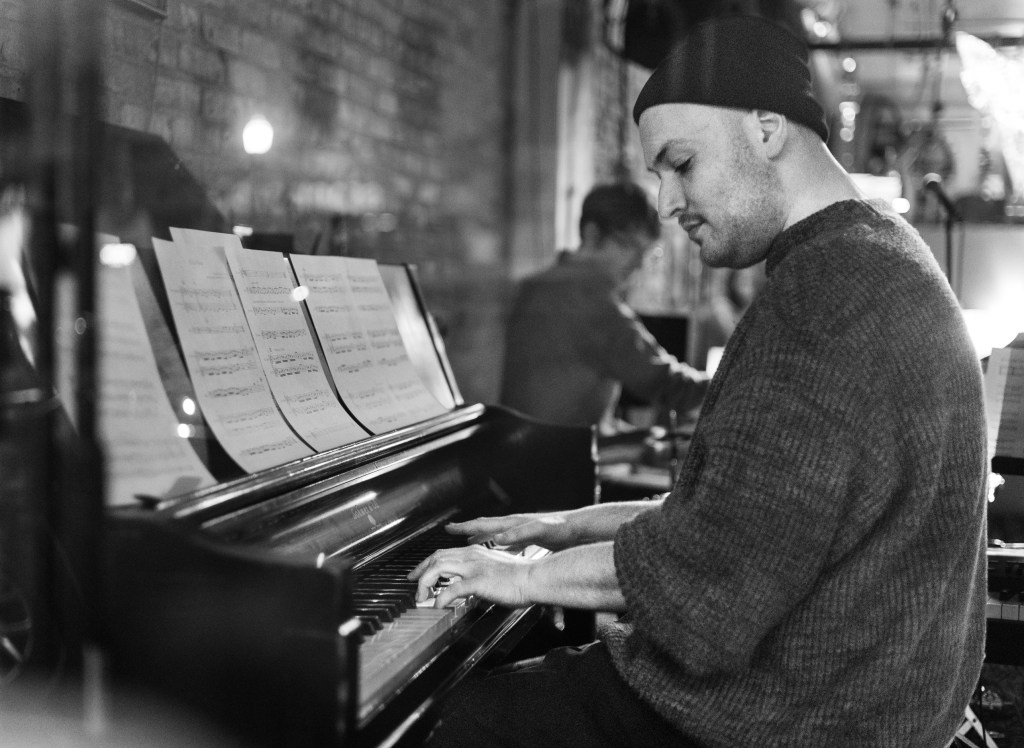
Teiku’s origin story feels almost pre-ordained. Co-leaders pianist Josh Harlow and percussionist Jonathan Barahal built Teiku on the foundation of the music they grew up singing: their Jewish-Ukranian ancestors’ Passover songs, unique to each respective family and passed down aurally over generations. It is worth pointing out how remarkable this is. The holiday of Passover is celebrated with liturgical songs, but for most American Jews, the melodies associated with these texts have become increasingly standardized. Harlow and Taylor’s families each steward a number of unique melodies that likely originated in their ancestral villages but survive only through their family lines. Despite both growing up surrounded by Jewish communities, neither knew of any other families with melodies of their own. The concept for the band had independently incubated for years inside the minds of the co-leaders, and both knew that these beautiful family melodies would somehow have a place in their musical futures. As luck would have it, the two met in the Detroit music scene and developed a strong musical chemistry, eventually discovering their strikingly similar histories and immediately setting out to make Teiku a reality. With these simple vocal melodies as source material, the two crafted multi-layered arrangements that act as rich spaces for improvisation. Sonically and spiritually, it is music that embraces the tenets of Creative Music.
Teiku is a Talmudic acronym that roughly translates to “unanswered question,” a fitting description of the process of discovery that creative improvisers know well: creating spontaneous and cohesive sonic environments that are felt viscerally but cannot be expressed in words. This project reflects its leaders’ musical and spiritual sensibilities: a yearning for insight, an acute sensitivity to the present moment, a space made for searching deeper.
 Teiku
Teiku 